

Anxiety: A Philosophical Guide
An exclusive excerpt from Dr. Samir Chopra and Princeton University Press

PAC would like to express their deepest thanks to Dr. Samir Chopra and Princeton University Press for this exclusive excerpt from Anxiety: A Philosophical Guide.

Dr. Chopra is an esteemed speaker at our virtual event this Saturday at 12 pm EDT: The Philosophy of Anxiety! There’s still time to reserve your spot! It’s free to register. Donations are welcome. If you’re unavailable on the day, not to worry. You can access the recording using the same link that was emailed to you.

Living with Anxiety
In acknowledging and accepting as inevitable, and living with, anxiety, we step a little closer to understanding who and what we are. If we are willing to sit with our anxiety, we may find it reflects our life’s most important decisions, our most personal and deeply held commitments and values, the inflexion points at which inchoate moods crystallize into, and identify, concrete fears. Anxiety, as psychoanalysis informs us, is a message to us from the many bits that hold us together; we should listen to, and perhaps resolve, what our often-conflicting selves have to say to each other. If we find ourselves persisting in a task despite the accompanying anxiety, we have learned an important lesson about the valuation and importance of that task in our psychic hierarchies. And if being anxious is a form of knowing, then it enables us to do something, to accomplish something; it may make us write about our anxieties, or address an insecure relationship, or work on “improving” or “bettering” ourselves in whatever dimensions we find ourselves lacking, whether moral or intellectual. We should not, of course, expect our anxieties to remain the same as we, and our lives in tow, change; by paying close attention to their nature, their look and feel, we can track changes in ourselves and our “table of values.” Anxiety is not singular; individual anxieties make up a sufferer’s full complement. An anxiety may be a distinctive suite packaged for application to a particular situation of time, place, circumstance, and connotation. To know oneself is very often an injunction to know one’s anxieties—individually, distinctively—and how they change and morph as we do, locked in a sympathetic dance of sorts.
As part of this navigation, we need to learn to recognize cultural and ideological triggers of our anxieties, to realize the damage done to our being by internalizing familial, social, and cultural advertisements of, or guilt-inducing admonishments to live, the “happy life.” The times of our lives are rarities, hopefully artfully and thoughtfully parceled out to our moral, familial, and intellectual commitments, but the cultural pressure on this time to perform is immense; every second must meet ideologically inflected, evaluative benchmarks for efficiency and consumption. The pressure for the perfect day—on vacation, at work, during leisure, during the week—grows; we see quite clearly—on social media—how our lives fall short of the supposedly ideal ones lived by our friends. A terror grows and festers within, shot through and through with a gnawing guilt: my life will not be the “best” (or even worth living); my work will not be the most fulfilling; my leisure time will not be the most rewarding; my children will not be the most precocious. My existential failure is foretold as these anxieties of guilt, and meaning, and purpose crowd our minds. Our life must acquire a certain number of (digital) approvals and endorsements to reassure us we have made the right choices. Anxiety is our response to the mythical requirement, the forbidding injunction in fact, that we must live according to normative standards drawn up for us, that this life and all its pleasures could be ours, if only we would do the “most essential,” “the best,” and not miss out on the “essential” or the “must-see.” We seek instruction in what we must do; and if we do not do things the way guidebooks—religious or moral texts, or corporate brochures—tell us, then we will have missed out on the right life, the magnificent views others have curated and held out to us as attractions. There is some right slice, some right or best view of this existential panorama, which we must endeavor to obtain. We are persistently reminded the worst sin of all is to not have lived “the right life”; that we are wasting our lives if we do not let the aesthetic of efficient utilization guide our every step, our every foray. We have talents; we have limited time; all is possible; all could be ours: if only we lived the right way. We know the counterpoints to these oppressive nostrums, but we cannot internalize them; conformity and ideology beat us down. We have too many guides for the perplexed; perhaps we should be more suspicious, as Nietzsche urged us to be, of moral instructions and life plans that create us in a “bad conscience,” saddling us with a guilt-stricken, anxious view of life; should we, perhaps, entertain uncertainty and the possibilities of the unlived life?
Our culturally entrenched norms, of course, promise us a path to happiness: the right education, the right job and material gratification, romance with the right partner, parenting kids who meet social standards of success and accomplishment, and so on. When we realize these conventional paths do not work, that the normative weight granted to prescriptions for life do not map on to the actual satisfaction to be attained from them, we develop an anomic relationship to this world, an acute, existential dissatisfaction with this world’s arrangements and imperatives and the life they force on us. Our self-directive is to accept there is no required solution, no correct path, and to settle for a plurality of perspectives and “life solutions.” The great Chinese philosopher Zhuangzi, through his dazzling, often-nonsensical philosophical poetry, urges us to maintain just such an ironic distance from the demands of this world; we must learn to practice a kind of detached engagement with the ensnarement this world offers. Our humanity lies in the gap between our sense of who we are and our sense of who we sense we might be; a distinctive shading and characteristic of this play of life is anxiety over whether we will lose our way in our journey across the divide. A pluralist approach to life can convince us that there was no path there to be lost, other than the one we made with our own steps, for even if we achieve culturally and socially recommended accomplishments, and meet prescribed milestones, anxiety sets up residence in our being. Our success does not protect us against anxiety; it merely gives us a different vantage point to experience it. The anxiety of the “successful” may be usefully contrasted with the anxiety of the still striving or the “failed,” but it is anxiety, nonetheless.
What we call “life problems,” or more fashionably, “life stressors,” are, of course, manifestations of acute anxiety. We find existential anxiety wherever major or minor life events occur (indeed, as the existentialist sensibility promises us, there is not and cannot be any such thing as a “minor” decision): changing undergraduate majors, divorces, moving cross-country, changing jobs, getting vaccinated, choosing a career or vocation or life path. These decisions are invitations to anxiety; they force us to commit, to accept final decisions, which foreclose other options, paths, and escapes; they force us to reckon with the tragic sense of life, that very often, we will confront dilemmas that will force us to irrevocably choose between two equally treasured values. This is especially true in the case of moral dilemmas, which when posed as puzzles might make us think there is a correct answer, waiting to be discovered or calculated by us. Unfortunately, there is not; you will get something “wrong” and be forced into an anxiety-ridden tragic corner. Nothing, therefore, is more terrifying than a fork in the road: in both directions lie the fear of the unknown, the anguish of cognitive dissonance, of regret.
Our life’s dilemmas, then, of which there is an endless supply, tempt us, ensnare us with fearful and ecstatic possibility. Like a perplexed and fearful Buridan’s ass, we vacillate endlessly and anxiously between the poles of choices, wallowing in stasis, in uncrystallized fears. Jorge Borges’s “garden of forking paths” is a veritable forest of anxiety as it confronts us with a profusion of choices, each partially visible and understood; here, there are too many possibilities, inducing in us a paralysis of freedom, especially when we sense we lack guidance, when we sense we cannot proceed without a map of each forking path. Because the future never ceases to be such a garden, our anxiety can never end; even as we head for our deathbeds, we, or our loved ones, will still have to make decisions: This medication or that? Continue treatment or discontinue? Quality of life or quantity of life? Should we spend the money on this expensive treatment or not? Who shall I favor in my will? Who shall I excommunicate as I die, making clear my displeasure at them as I depart into oblivion?
As an illustration of the centrality of anxiety to conventionally understood “life problems,” consider the supposed “midlife crisis,” an acute anxiety of meaning and responsibility visible in the questions it raises, which resonate with the taxonomy of anxieties posited by Tillich: Is this all there is? Have I made “enough” of my life? Have I lived the “right” life? I made so many decisions; look at the pass they have brought me to; why did I not make others? Time is running out; which ones of my desires must I satisfy? The midlife crisis is, most profoundly, a species of anxiety about the life lived and not lived thus far, and the life yet to be lived. Prescriptions for resolving it are solutions for anxiety: we should engage in ongoing acts of creation and contemplation, in never-ending, “atelic” projects with no defined goals or end points such as playing guitar, as opposed to learning guitar to perform at Carnegie Hall; we should dedicate ourselves to social and larger causes, whose periods of resolution exceed our lifetimes; we should allow our creativity to flower through engagement with the wider world; we should enter into a sincere commitment to relationships with family and friends, treasuring the time we spend with them, recognizing it as the existential good par excellence whose presence in our lives we should strive to maximize; we should be good examples, even in the face of our fears, to those we love, for how to live and die. If life is “a journey with destinations,” we have anxiety about “arrival,” about “the wrong destinations,” about “failure to complete journeys,” about “getting lost by taking the wrong forks”; but if there is “only travel, onward,” we can sink back, fully cognizant that around the next bend may lie terrors yet unimagined. The so-called project or bucket-list life, as the Buddha might have warned, is characterized by signposts for failures; failure to achieve a project is cause for sorrow, guilt, and self-flagellation, while success in achieving one is merely occasion for ennui and doubt and the restless look for yet another project, and for the anxiety arising from guilt over the list’s still-incomplete status.
Can I “heal” myself of my anxiety without “losing” myself? This seemingly absurd question captures the instinctive sense we have that we, our selves, are complex physical, conceptual, and affective structures; a body, a set of beliefs, a complex of interrelated emotions; change your anxiety, and you change yourself; you cannot change one thing without changing everything else, for I “own” my anxiety, as part of my own distinctive personality and “style”; it animates my every step, my every resolution. Those who take psychiatric medication often find “parts” of their personality “gone missing,” rendering them unrecognizable to their friends and sometimes to themselves; this mixed blessing may not be acceptable to all. This anxiety, the one that has made me pursue philosophy, and hiking and climbing, which has made me reorder my life since my precious daughter was born, since I resolved to enter the commitment of a lifelong partnership with her mother: without it, I would not recognize myself. My anxiety renders my existence in this world a distinctive and singular aspect; my anxiety is what makes my “being-in-the-world” what it uniquely is.
The Buddha considered the supposed eternal, immortal, unchanging self to be a dynamic bundle of ever-changing perceptions and thoughts and images; we are, too, a bundle of anxieties. By examining them—to see what vexes us, makes us anxious—we come to know who we are. Anxiety is a reminder that our selves are more diffuse and disorderly than we might imagine, that there are more bits to be seized as they swirl about and inside us. If our world “cannot be understood independently of the emotional reaction through which the world’s nature is revealed,” then the world we live in is shaded by our anxiety; to learn to live with it is to change the nature of the world we inhabit.
I am an anxious person; I respond with anxiety to this world’s offerings. I am a better person for my knowledge of this state of affairs; by learning about my anxieties, I have gained an acute self-knowledge about my life, my passions, my commitments, my deepest fears. In writing about anxiety, then, I must indulge in autobiography. For instance, unsurprisingly, I experienced visceral anxiety while writing this book. I associate anxiety with writing and writing with anxiety; it informs my nervous return to the writing desk, the hurried stepping away from it, the persistent seeking of distraction online or elsewhere, the panicky procrastination on the production of a readable draft, my persistent dissatisfaction with what I write, my relentless self-castigation and self-doubt over the words I put down on paper. But anxiety about what I write informs me writing is valuable to me, that failure here means failure everywhere for me. Without my own peculiar anxiety, I would not be the writer I am; I would not be the father, the husband, the friend, the professor, the climber, the philosophical counselor I am.
The psychic burden of anxiety, then, may be offset by the gains in self-knowledge it affords; to experience anxiety is to experience our social self, with its attendant cultural and moral responsibilities, in the making. When we experience and work through the dissonance generated by anxiety-provoking decisional forks of choice and relinquishment, the resultant conflict and self-examination can be acutely productive of such knowledge too. A living with the phenomenology and the felt experience of the anxiety, then, a conscious wallowing in and inspection of it, can enable an investigation of the self; anxiety, as Kierkegaard claimed, is a “school” for the self; and such sites of learning are frequently those of examination, of brutal testing of our limits. Because of my anxieties, I have come to understand why I am the philosopher I am, why I hold the views I do, why I do not trust that there is an inherent, essential, meaning or purpose to life, a final truth waiting to be discovered. My anxiety, an emotion and feeling, is intimately related to a hard-won knowledge about this world’s eternally changing nature, one that often runs afoul of human plans or intentions or attachments or relationships.
My anxieties tell me I am still capable of feeling; they provide an acute reminder that I am alive and responsive, and yes, anxious. My anxieties about my family, my wife, my daughter, inform me that I have let myself become wrapped up in their selves; they inform me of the risibility of the claim that we are isolated beings whose boundaries terminate at our fingertips, at the surface of our skins; they inform me of what my self is. Thus does anxiety inform me of who I am.
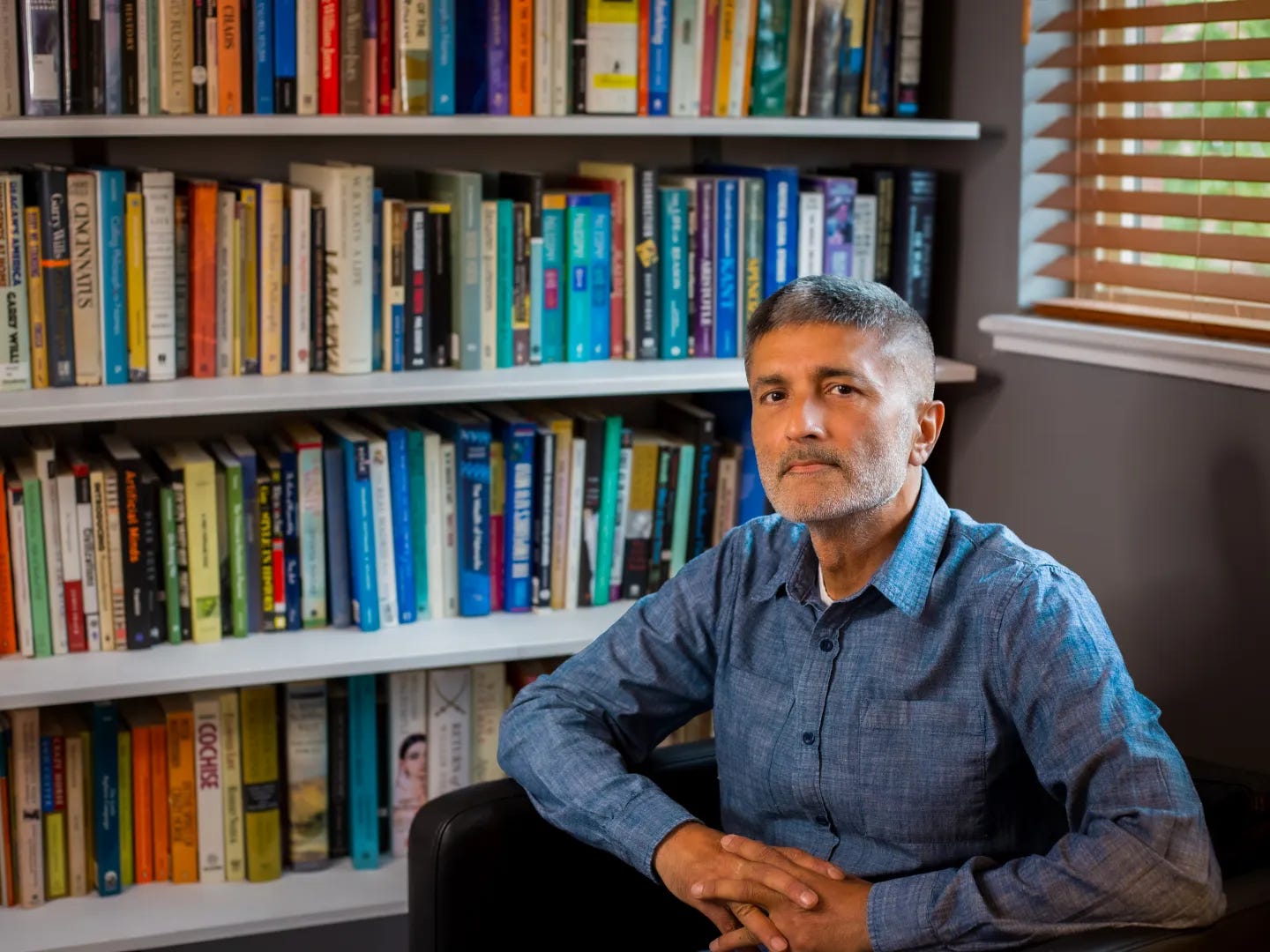
Samir Chopra, Ph.D., is Professor of Philosophy at Brooklyn College and the Graduate Center of the City University of New York. His academic interests include pragmatism, Nietzsche, the philosophical and legal foundations of artificial intelligence, philosophy of law, and the politics and ethics of technology. He is currently writing a philosophical guide to anxiety. Samir is a certified philosophical counselor and writes online at samirchopra.com.